The journey of a child through cancer treatment is a harrowing one with multiple scans, tests, drug treatments and observations. We believe in minimising this and making the journey better. Many children going through treatment collect a bead for each intervention, scan, bone marrow procedure and each of the other things they go through during cancer treatment. Programs such as the beads of courage or the beaded journey aim to allow children to visually share their treatment journey and to reduce hospital anxiety. You might imagine how this amounts to a bracelet-size thread, but I’ve seen strings of beads several metres long. When you see them laid out, you get a sense of how much we ask of these children. I’d like our research to take some of those beads away.
Think about what it takes to do an MRI on a six-month-old. An adult can usually lie still when asked. A baby will often need to be sedated. Then, there’s getting to the hospital in the first place. Children’s cancer care is concentrated in specialist centres, so families may have to travel far from home. A parent may go with the child while the rest of the family stays behind. That can take away some of the stability a child needs most and add so much more stress, and financial pressure, to the whole family.
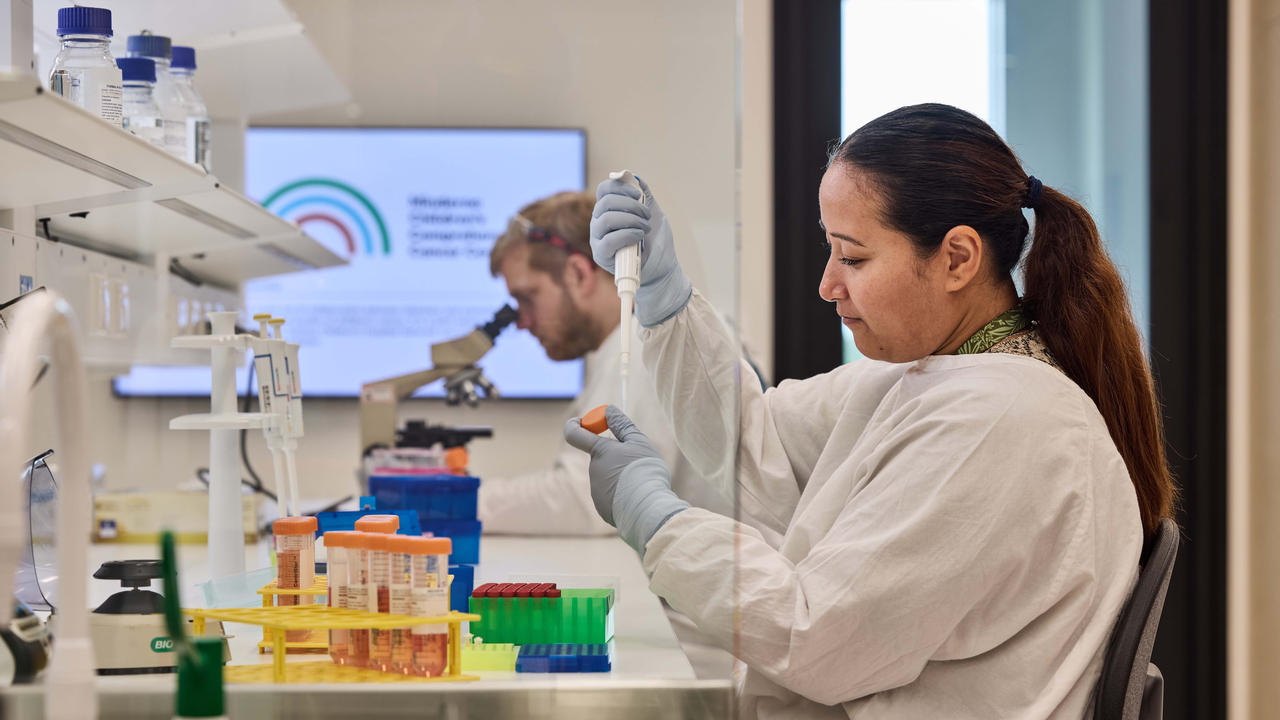
Surely much of that monitoring can be done through a simple blood test. That’s the idea behind liquid biopsy. We take a blood sample and look for evidence of cancer, including tiny fragments of DNA released by tumour cells. If we can reliably pick up those traces, we may be able to check how well treatment is working or look for early signs that the cancer is returning. In time, some children might be able to have blood drawn at their local GP’s practice and spend more time at home.
It’s the kind of problem that drew me to the Zero Childhood Cancer Program. My route into the work took me through veterinary science, archaeology and anatomy, and then into prostate cancer research. In that lab, I became interested in the technology we used to sort cells and characterise disease. Learning how the equipment worked took me towards electrical engineering. Now I spend much of my time working between engineers, biologists and clinicians, making sure the technology we build can answer a question that matters for a child.
When we first proposed using liquid biopsy to monitor childhood cancer, some people told us it wouldn’t work. You’re looking for traces of tumour DNA that can be very hard to find. And two children with the same diagnosis may have different genetic changes in their tumours. We use information from each child’s tumour to design a test that looks for hundreds of clues in their blood. Each clue gives us another chance to pick up a signal.
I expected the biology to be difficult. What surprised me was how much of the process we had to work out from scratch. We had shipments of temperature-sensitive lab supplies sit at customs until the dry ice melted and the materials spoiled. We also had to build a way to turn sequencing data we’d never seen before into a report a clinician could use, within weeks. Developing the blood test meant working through all of that as well.
We tested blood samples from children with leukaemia, brain cancer, neuroblastoma and sarcoma. Among children with solid tumours, those with detectable tumour DNA in their blood generally had poorer outcomes. That gave us reason to think the signal could tell us something about how a child’s disease was progressing.
We also picked up tumour DNA in the blood of some children with brain cancer. There had been real doubt about whether we could see a signal in blood because of the blood–brain barrier. Finding it in some of those children gave us a reason to keep investigating when blood monitoring might work for them. In leukaemia, the results suggested that a blood sample might one day spare a child some of the procedures needed to collect bone marrow.
We’re still working out which children the test can help and when a result could inform their care. Each time we see a pattern again, we have more to draw on when the next child’s result comes through. That’s what I’d like this work to lead to. If we can give a clinician the information they need and spare a child even one or two invasive procedures (such as bone marrow aspirates or sedation for MRI scans), those are beads that the child never has to add to the string.